What’s going on, everybody? The Apprentice here, finally making my way back to the blog here at The Apprentice Corner.
First off, sorry for the absence. Life has been crazy, as it normally is this time of year. I work in the tech industry, and the stretch between now and Thanksgiving is basically a race to the finish line. Everybody is trying to get projects wrapped up before the end-of-year freeze hits, vendors slow down, hardware becomes harder to get, and suddenly everything gets pushed into January.
That being said, I haven’t been entirely idle…
I have several blog posts in the works, a couple reviews I’ve been sitting on for a while, so there’s plenty coming down the pipe.
In the meantime, though, I wanted to throw out something I’ve been chewing on lately.
It started as a conversation about gear, but the more I thought about it, the more I realized it applies to almost anything we buy:
What actually counts as innovation?
Functional Innovation vs. Financial Innovation
When most of us hear the word innovation, we probably think about what I’d call functional innovation.
A company develops a new product or improves an existing one. Maybe it performs better, lasts longer, weighs less, produces more output, or adds some capability we didn’t have before.
Basically, somebody spends time and money on research and development and comes out the other side with something better.
That is innovation in the traditional sense.
But there’s another type that I think gets overlooked:
Financial innovation.
And no, I don’t mean Wall Street.
I mean finding a way to manufacture and sell a product that accomplishes most of the same job as the premium option, but for considerably less money.
Maybe it isn’t quite as powerful. Maybe the materials aren't as exotic. Maybe the fit and finish isn't as polished. But if something gives you 80% of the performance for 50% of the price, I think that deserves to be called innovation too.
The Constant Chase for “The Best”
I think financial innovation gets ignored largely because of the culture surrounding gear.
We’re always chasing whatever is newest, hottest, brightest, strongest, or most feature-packed.
And listen, I get it.
I like nice gear too.
I’ve been extremely fortunate over the years. I’ve had friends give me some really nice gear as gifts or hand-me-downs, and I’ve had opportunities to purchase certain products through programs and discounts that aren't necessarily available to the average consumer.
So I've ended up with some genuinely premium stuff.
But I’m also pretty frugal when I’m spending my own money.
These days, I’m mostly a family man. Dropping a bunch of money on something that's purely for me becomes a much harder value proposition when there are a hundred other places that money could go.
So, increasingly, I’ve become what I affectionately call a Walmart Warrior.
And honestly?
It has been kind of fun.
The “Walmart Warrior” Philosophy
I’ve spent a lot more time researching, buying, and testing cheaper products over the last few years.
Shout-out to brands like Ozark Trail and Hyper Tough.
Not everything they make is a banger - let's be realistic here. But there are absolutely products in that world that make you stop and say:
"Wait…this only costs how much?"
That’s where my fascination with financial innovation really comes from.
The question isn't always:
What is the absolute best version of this product?
Sometimes the better question is:
What is the least amount of money I can spend and still get something that reliably does what I need it to do?
Those are two very different buying philosophies.
And importantly, neither one is necessarily wrong.
Flashlights are probably one of the easiest places to see this play out.
And anybody who has spent time in the flashlight world knows that particular rabbit hole gets deep in a hurry.
You can go from whatever is hanging on the shelf at Walmart, Tractor Supply, or Home Depot all the way up through more premium-minded manufacturers. I own lights across that spectrum, including some higher-end stuff, and I've experimented with a lot of different philosophies about what makes a light "worth it."
More recently, Olight has caught my attention again.
I haven't personally spent a ton of time with their newer lights yet, but a buddy at work is a big fan and has been pushing me to give them another look. Some of their current models are interesting enough on paper that I think I'm finally going to pick up a few and spend some real time with them.
But that decision also brings me right back to the point of this article.
Because what are you actually buying?
Do you need the absolute highest output?
Do you need extreme candela and throw?
Is this a defensive light that absolutely needs to work under the worst possible conditions?
Or do you just need something small, rechargeable, bright, and dependable enough to carry around every day?
Those use cases don't necessarily demand the same solution.
Sometimes 80% Is Enough
This is probably the biggest lesson I've learned as I've gotten deeper into EDC over the years.
You have to define the job before you can decide what something is worth.
There are absolutely situations where spending the extra money makes sense.
Sometimes that last 20% of performance is exactly what matters. Durability, reliability, materials, warranty support, output, waterproofing, manufacturing quality, or simply knowing that a piece of equipment has been designed around a specific demanding use case can absolutely justify spending more.
But sometimes you're paying a considerable premium for capabilities that you'll never actually use.
If a $40 tool reliably handles everything you ask of it, then a $150 version isn't automatically $110 better for you.
That's where I think we sometimes lose perspective in the gear world.
The best product isn't necessarily the product with the best specs. It's the product that best fits the job you actually need it to do.
Where I’m Going With All of This…
This isn't just philosophical rambling. Well...maybe it's mostly philosophical rambling.
But I do have something coming that ties directly into this conversation.
I'm working on a comparison between a larger, more expensive, premium-minded multi-tool and a significantly cheaper alternative.
Anybody who has followed me for a while knows I have a lot of opinions about multi-tools. I've carried them, collected them, tested them, and gone back and forth on what features actually matter more times than I can probably count.
So rather than simply asking which tool is better, I want to look at a slightly different question:
When should you spend the extra money to upgrade, and when should you keep that money in your pocket?
Because those aren't always the same answer.
And I think that's where this idea of financial innovation becomes really interesting.
We tend to associate innovation with cutting-edge technology. New materials. Higher numbers. More features. More power.
But sometimes innovation is a company figuring out how to make something almost as good for considerably less money.
And depending on what you actually need that product to do, that might be the more meaningful innovation of the two.
Anyway, this is mostly just something to get the gears turning while I finish up some of the bigger stuff I've been working on.
The next time you're looking at a piece of gear, don't just ask which one is best.
Ask yourself:
What job do I actually need this thing to perform?
Which features will I realistically use?
What am I gaining by spending more?
What am I giving up by spending less?
And does that difference actually matter to me?
Sometimes buying premium is absolutely worth it.
Sometimes the Walmart special does the job just fine.
Knowing the difference might be one of the most valuable skills you can develop as an EDC enthusiast.
I've got a bunch more content coming soon, and thankfully most of it is finally out of the "I should really work on that" phase and into the editing phase.
So stay tuned.
I'll see you guys soon here at The Apprentice Corner.
Later on…
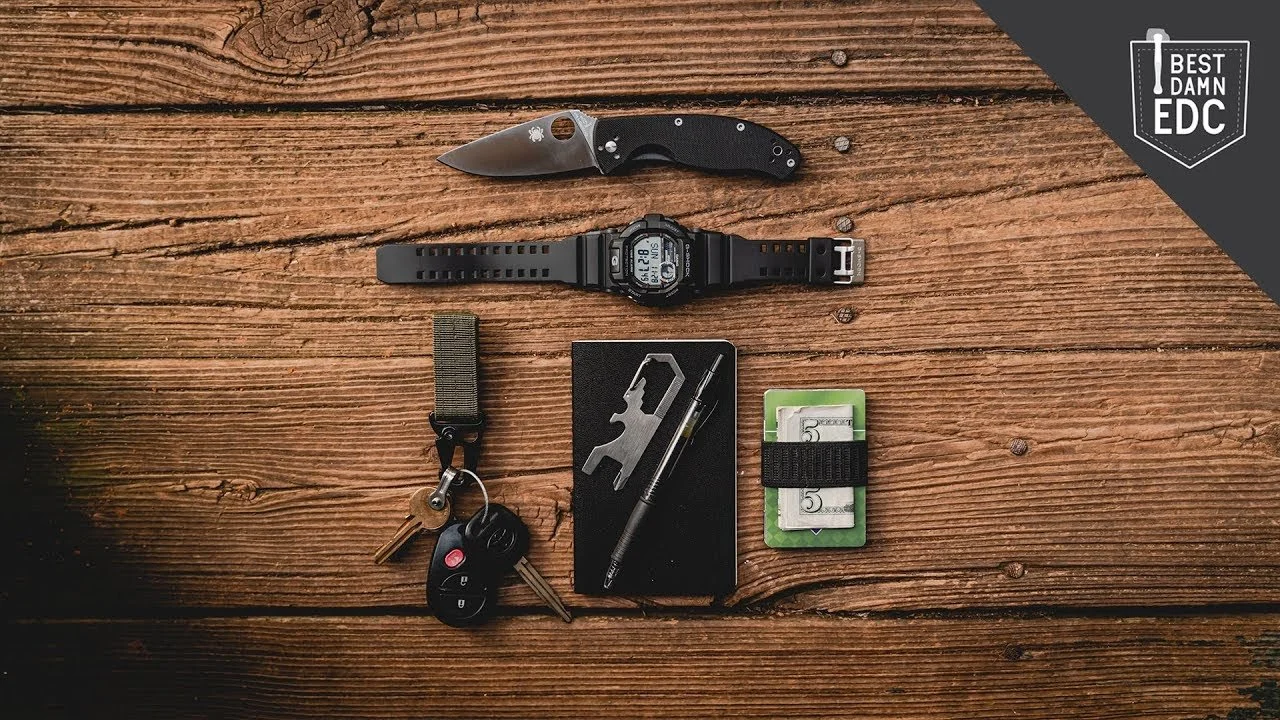
As usual - Taylor Martin @ Best Damn EDC Made a video about Walmart EDC some time ago, and its def worth checking out if youre into budget minded gear that may not do anything too special, but financially its less of an investment for some of the same fucntionality of higher end gear!